

Methodological and cross-sectional implementation research

Our research
In addition to our various areas of specialization, such as the rural cohort Saxony-Anhalt (LäKoSA), psychosomatics, or emergency and intensive care medicine, we also address overarching implementation questions. One key topic is the development of an instrument to measure readiness for implementation (Readiness for Implementation Scale, RIS)—a specific type of readiness for change, if you will—as well as the current status of integrating patient reports into treatment, specifically digital patient-reported outcome measures, or ePROMs.
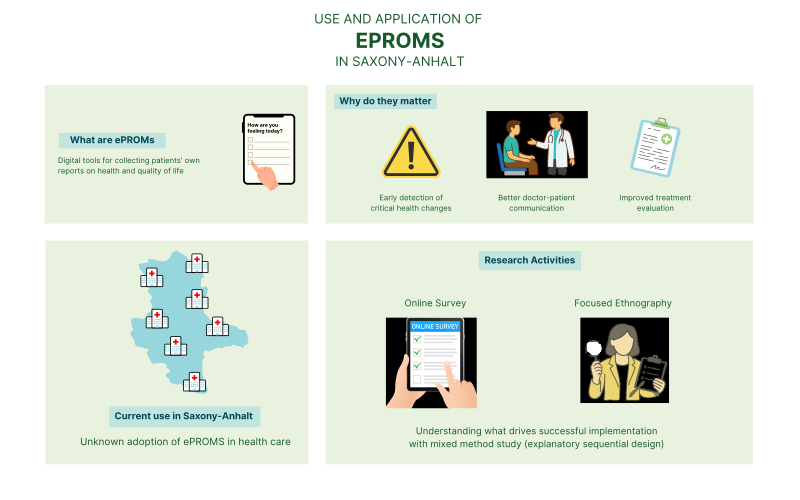
Patient reports on health status, quality of life, and treatment experiences—known as Patient-Reported Outcome Measures (PROMs)—allow for the incorporation of patients' subjective assessments into the treatment process. This ensures a continuous overview of the individual's overall situation, even outside of doctor and hospital visits.
PROMs capture symptoms and limitations that often go unnoticed during regular consultations. They can identify a decline in a patient's health early on, improve doctor-patient communication, and contribute to evaluating the effectiveness of medical interventions.
The use of PROMs strengthens the patient's perspective and gives greater weight to their experiences within the care process. Electronic implementation (ePROMs) simultaneously increases efficiency and practicality. When applied correctly, they enable low-threshold feedback, technology-supported analysis, and automatic alerts for critical entries.
To date, however, patient reports in clinics are only collected sporadically in Germany—whether in written, verbal, or electronic form. To establish the prerequisites for a systematic and widespread application of ePROMs, an initial assessment is required to determine the current state of usage. A subsequent observational study (focused ethnography) aims to provide in-depth insights into successful and less successful implementations of PROMs/ePROMs.
Measuring implementation success is a recurring subject of critical debate in current literature. However, the extent to which practitioners are actually prepared to implement these changes remains unclear and under-researched. Therefore, the goal is to develop a scale to measure the motivation of healthcare professionals to implement innovations and evidence-based practices.
The aim of this project is to provide a scientifically sound instrument that captures the willingness and drive of professionals to integrate new concepts into their practice. The scale is intended to help better understand the barriers and facilitators of implementation and to develop targeted support strategies.
Specifically, an existing scale used to measure patients' motivational readiness for change will be adapted to reflect the perspective of healthcare professionals regarding their readiness for implementation.
The following steps are planned:
• Adaptation of the items through various expert surveys
• Validation of the scale through our other projects
In doing so, the project contributes to improving the quality of care and the sustainability of innovations in the healthcare sector.

Would you like to support our studies?
Do you have any questions, suggestions, or an interest in participating as a study subject or collaborating with us on research? Please feel free to email or call us.
Team
News
Find updates on events, publications, and other news from our projects here.
Partner

Institute for Social Medicine and Health Systems Research (ISMG) Faculty of Medicine, Otto von Guericke University Magdeburg
University Clinic for Psychosomatic Medicine and Psychotherapy (KPSM), University Hospital Magdeburg A.ö.R.

Städtisches Klinikum Dessau, Collaboration Partners in the Teleconsultation Subproject

Johanniter-Krankenhaus Stendal, Collaboration Partners in the Teleconsultation Subproject

Prof. Michel Wensing, PhD, Chair of Health Services Research and Implementation Science, Faculty of Medicine, Heidelberg University
Adjunct Prof. Christoph Nikendei, MD, PhD and Nadja Gebhardt, Department of General Internal Medicine and Psychosomatics, Heidelberg University Hospital
Prof. Robert Werdehausen, MD, Department of Anesthesiology and Intensive Care Medicine, University Hospital Magdeburg


