

The project examines the implementation of scientific findings in highly dynamic care environments.

Our research
In sub-project A, we are investigating how evidence-based care and follow-up concepts for patients during and after emergency and intensive care can be implemented in medical practice.
We are analyzing barriers, facilitating factors, and contextual conditions to contribute to sustainably improved care through targeted implementation strategies.
The perspectives of physicians, nursing staff, allied health professionals, and patients are systematically taken into account. The goal is to gain and apply robust insights into the conditions for successful evidence-based care, with a particular focus on the structurally disadvantaged region of Northern Saxony-Anhalt.
The primary goal of the "Inventory and Mapping" project is to provide health reporting on the state of care in Saxony-Anhalt. Geographic data, such as the density of general practitioners or the accessibility of clinics, is visualized using interactive maps, providing a foundation of information on various care-related issues, including emergency and intensive care medicine. This information, such as the status quo of the current care situation in the municipalities of Saxony-Anhalt, is made available to both the public and healthcare stakeholders via the ISA project website.
In addition, this project conducts analyses on specific research questions in the field of intensive and emergency care. For example, we are currently investigating whether there are gender-specific differences in the symptoms of patients with acute ischemic heart disease upon arrival at emergency departments. The results will also be incorporated into the visual representations.
Wencke Schindler, Kirti Rawal, Benedikt Tanzer

Swallowing disorders (dysphagia) often occur as a result of various medical conditions, such as strokes or post-surgery. They can be associated with malnutrition, respiratory distress, and the risk of choking due to the aspiration of food or liquid, making them potentially life-threatening for those affected.
One possible treatment approach is to adjust the consistency of food and drinks to meet the individual needs of patients (diet modification) to enable natural and safe nutrition. Standardized terms and descriptions for the various levels of diet modification (also known as dysphagia diet levels) are essential to avoid misunderstandings between healthcare providers, for example, during hospital discharge or transfer to another facility. If dysphagia diet levels are not understood consistently, patients may receive unsuitable food, which increases the risk of life-threatening complications.
With our project, we aim to develop recommendations for standardizing dysphagia diet levels in outpatient and inpatient care in northern Saxony-Anhalt. In our first study, we are conducting an online survey of professionals who recommend diet modifications (e.g., physicians, speech therapists, nursing staff) to gather information on the current use of dysphagia diet levels in the region.
Building on this, we will conduct a second study in collaboration with other experts to develop strategies for implementing standardized dysphagia diet levels. This will make a valuable contribution to improving patient safety throughout the entire care process.
Denise Walther, Wencke Schindler

Liver cirrhosis (scarring of the liver) is frequently associated with sarcopenia—a loss of muscle mass and strength. This is driven by factors such as inflammatory processes, inadequate protein and energy intake, and the accumulation of substances that the liver would normally break down (e.g., ammonia). In daily life, this manifests as reduced physical performance, an increased risk of falls, and often longer hospital stays. Studies suggest that nutritional therapy combined with targeted strength and endurance training can counteract this.
However, there is a gap between research findings and clinical practice: in the daily hospital routine, good ideas often fail due to workflows, unclear responsibilities, time pressure, or technical hurdles. Our current project phase therefore focuses first on identifying barriers and facilitators along the care pathway—including an assessment of where digital or AI-supported tools (e.g., for personalized therapy planning) can be meaningfully integrated without replacing the clinical decision-making process. In parallel, we are developing a clear care pathway at the university hospital that reliably implements combined nutrition and exercise therapy—with defined roles, streamlined processes, and simple, practical tools (e.g., standardized screening and clear triggers for initiation). A specific focus is placed exclusively on pre-TIPS patients and liver transplant candidates (pre-LTx).
In later project phases, we will evaluate the impact using handgrip strength and body composition (BIA measurement) as indicators and add a health economic model of the intervention. The goal is a sustainable care pathway that brings the proven combination of nutrition and exercise to where it matters most: to the patients—within the real-world treatment workflow.
Alexander Töws, Jun.-Prof. Dr. Claudia Buntrock

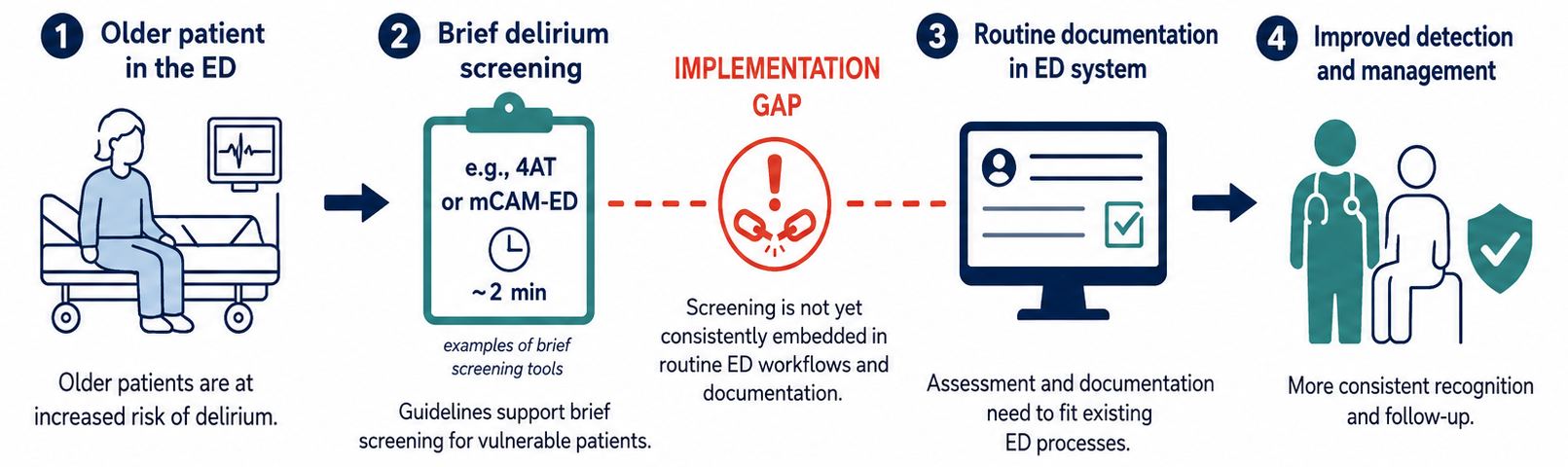
A delirium is an acute state of confusion in which people suddenly lose their orientation, experience hallucinations, or undergo significant behavioral changes. Some patients are noticeably restless and loud (hyperactive delirium), while others appear quiet, drowsy, or apathetic (hypoactive delirium) – and it is precisely this form that is often overlooked. Older or critically ill patients are particularly at risk, for example following infections, surgeries, medication use, or dehydration. Delirium is common and can have serious consequences: if it is not recognized and treated, the risk of complications, a need for long-term care, or even death increases.
Despite these risks, delirium is rarely systematically screened for in emergency departments. Our research project investigates why this is the case and how detection can be improved.
Through interviews with nursing staff, triage personnel, and physicians at hospitals in northern Saxony-Anhalt, we are documenting how delirium is managed in daily practice and what barriers exist to implementing current recommendations (recommendations from the DGPPN; S3 guideline the DGGPP and DGG). We are particularly interested in the role of structured screenings—short tests consisting of just a few questions, such as the 4AT —and what is realistically feasible in everyday clinical practice to identify at-risk patients at an early stage.
The findings will help develop practical strategies to ensure that delirium in emergency departments is detected earlier and that affected patients receive better care.
Jasmin M. Kizilirmak, PD Dr. rer. nat.
Cindy Gerberding, cand. M. Sc. Psych.
Freya Auner, cand. Dr. med.
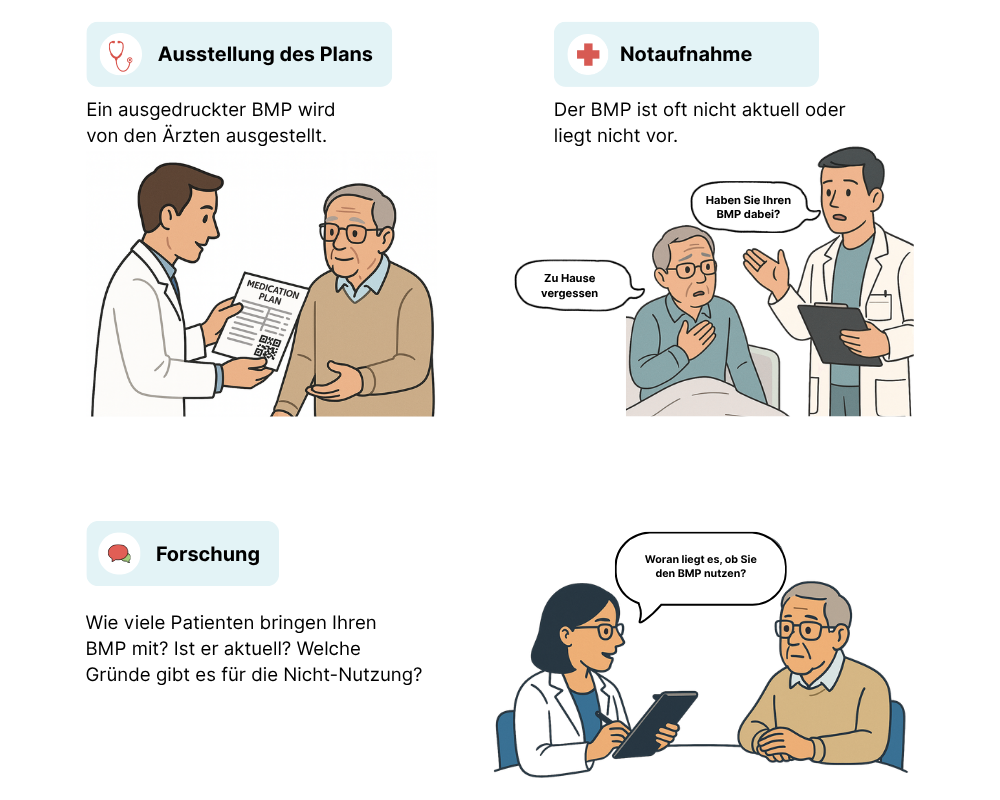
To improve medication safety, patients in Germany taking three or more long-term prescriptions are legally entitled to a standardized national medication plan (Bundeseinheitlicher Medikationsplan, BMP). This vital document is intended to provide medical staff with quick and reliable information about a patient's current medication, especially in emergencies. However, the reality in hospitals is different: paper-based plans are often not brought to the hospital by patients, or they contain errors and are outdated. As a result, the original goal of increasing patient safety is frequently missed.
This is where our research project at the University Hospital Magdeburg comes in. In a scientific study, we are investigating the everyday reasons for this implementation gap directly in the emergency department. The focus is on the patient's perspective: what are the concrete, practical barriers that stand in the way of seamless and correct use of the plan? By systematically analyzing these hurdles, we aim to understand why the current system fails in practice.
The goal is to create an evidence-based foundation. Our findings are intended to help ensure that future solutions—especially upcoming digital ones—are tailored to the real needs of users and effectively and sustainably improve medication safety in Germany.
You can find further information on the standardized national medication plan here:
Would you like to support our studies?
Are you from Saxony-Anhalt and currently working in emergency or intensive care, or have you been a patient in these departments?
We would be happy to check if you are eligible for one of our studies.
Are you a healthcare practitioner?
Are you working in emergency or intensive care medicine and would like to learn more about our projects or explore a potential collaboration?
Please feel free to get in touch – we look forward to hearing from you.
Team
News
Here, we share updates on events and the progress of our studies.
Partner

Institute for Social Medicine and Health Systems Research (ISMG) Faculty of Medicine, Otto von Guericke University Magdeburg
University Clinic for Psychosomatic Medicine and Psychotherapy (KPSM), University Hospital Magdeburg A.ö.R.

Prof. Michel Wensing, PhD, Chair of Health Services Research and Implementation Science, Faculty of Medicine, Heidelberg University
Adjunct Prof. Christoph Nikendei, MD, PhD and Nadja Gebhardt, Department of General Internal Medicine and Psychosomatics, Heidelberg University Hospital
Prof. Robert Werdehausen, MD, Department of Anesthesiology and Intensive Care Medicine, University Hospital Magdeburg
Contact
If you are interested in participating in our studies or have any questions about our research, please feel free to contact us.


