

Digitalization is transforming not only social practices, forms of communication and organization, but also societal structures and political orders. It is also fundamentally changing the conditions under which society produces subjects, shapes modes of subjectivation, and enables or limits certain forms of subjectivity.
The question of subjectivation and subject determination (How do individuals become specific subjects, and through which attributions, orders, and self-relations are they positioned and defined?) in the digital age was the focus of the network conference "Digitality and Subject", which took place on February 26 and 27, 2026, at Freie Universität Berlin. The conference addressed the particular social significance of medicine and health with two relevant panels: one dedicated to mental health apps and another focusing on digital health in a broader sense.
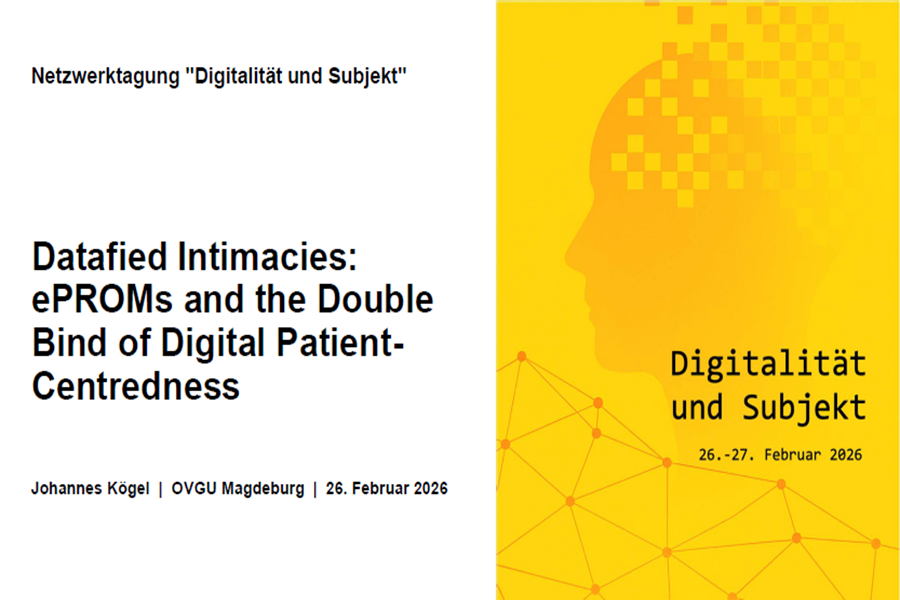
As part of this second panel, Dr. Johannes Kögel presented his ongoing research project on ePROMs (electronic Patient-Reported Outcome Measures). Under the title "Datafied Intimacies: ePROMs and the Double Bind of Digital Patient-Centredness" , he used the example of ePROMs to highlight the ambivalence of digital technologies in healthcare: on the one hand, they promise greater patient-centeredness and empowerment, while on the other, they are accompanied by standardization, formalization, and a shift in responsibility.
With regard to processes of subjectivation, a dual mechanism emerged: on the one hand, patients are addressed and produced as authors of authentic self-narratives; on the other hand, these self-reports are integrated into regimes of clinical and administrative surveillance. Thus, ePROMs do not merely measure experiences, but simultaneously define what is considered and recognized as a legitimate patient self.

