

The focus is on examining the implementation of measures in highly relevant areas of psychosomatic medicine.

Our research
Research project B in psychosomatic medicine comprises three innovative sub-projects focused on improving psychosocial care in Saxony-Anhalt. Our work centers on introducing a psychosomatic teleconsultation service in rural regions of Saxony-Anhalt, implementing digital diaries in psychosomatic care, and advancing primary suicide prevention through various proven, evidence-based measures.
Why this matters
Mental health conditions are among the most common health issues today. At the same time, patients often face long wait times and gaps in care. Telemedicine offers the opportunity to provide help more quickly, respond more flexibly to individual needs, and strengthen psychosomatic care as a whole. Through our research, we aim to help harness these opportunities in a responsible and effective way.
What we do
Analyzing success factors: We systematically investigate the conditions that facilitate or hinder the use of telemedicine in psychosocial medicine. To do this, we use both qualitative methods (e.g., interviews, focus groups) and quantitative approaches (e.g., surveys, statistical analysis).
Developing and testing model projects: Through pilot projects, we test telemedicine applications that support the detection and treatment of mental health conditions. This allows us to determine which technologies are practical and how they can support patients in their daily lives.
Evaluation and further development: We evaluate these projects specifically from an implementation perspective—looking not only at whether the technology works, but also at how well it is accepted, what obstacles exist, and what improvements are needed. We are making psychosomatic care in Saxony-Anhalt digital, accessible, and future-proof.
Saxony-Anhalt currently has the highest suicide rate of all German federal states. Our pilot project addresses this exact issue: the goal is to implement effective, evidence-based suicide prevention strategies and evaluate them scientifically.
In implementing our suicide prevention measures, we follow the recommendations of the National Suicide Prevention Strategy and the European EAAD (European Alliance Against Depression) program. The widely tested 4-level approach serves as the foundation for our project.
We focus on:
Our goal: A sustainable contribution to suicide prevention in Saxony-Anhalt – for greater awareness and better care.

We are gathering data on public knowledge, attitudes, and information needs regarding suicide.
Through events, campaigns, and targeted communication, we work to destigmatize suicide and break down the taboos surrounding it.
We actively involve municipal and regional stakeholders throughout the entire implementation process.
We train healthcare professionals—particularly those in primary care—on how to support individuals at risk of suicide. Furthermore, we are working to firmly integrate suicide prevention into the core curriculum for psychosomatic primary care.
We are currently assessing the need for a dedicated central platform for those affected, their families, and interested individuals in Saxony-Anhalt. If there is sufficient demand, we will establish such a platform to provide accessible information and support services.
In many regions of Saxony-Anhalt, there are very few specialists in psychosomatic medicine. This means that patients who are physically ill and also suffering from emotional distress often do not receive the appropriate support quickly enough.
This is exactly where our project comes in. We are creating a digital teleconsultation service that connects other clinics with us, enabling rapid exchange with psychosomatic experts. Doctors in smaller hospitals can easily obtain professional advice for their patients directly via a secure online platform.
The goal:
Furthermore, the project is investigating how well the digital consultation service is received by patients and staff, what barriers exist, and which factors contribute to its success.

The planned project aims to establish ePROMs (electronic Patient-Reported Outcome Measures) as a digital diary method in everyday clinical practice. Participants answer short questions about their current experiences at various times. This makes it possible to systematically capture the well-being and physical and mental health status of experts by experience in a way that reflects their daily lives. This form of diary study is known as Ecological Momentary Assessment (EMA) or the Experience Sampling Method (ESM).
As part of this sub-project, the implementation of the EMA/ESM method is initially being examined in two areas of application:
The results will be used to support therapies in everyday life and to specifically improve clinical care.

Are you a practitioner?
Your perspective matters to us! We work together with practitioners to design care services that meet real-world needs. Please feel free to get in touch!
Team
News
Find the latest information on interim results, upcoming events, and news regarding the project here.
The conference season is starting again.
The conference season is starting again.
The conference season is starting again.
The conference season is starting again.
Between January and March 2026, four focus groups with regional stakeholders were held on this topic.
Between January and March 2026, four focus groups with regional stakeholders were held on this topic.
Between January and March 2026, four focus groups with regional stakeholders were held on this topic.
Between January and March 2026, four focus groups with regional stakeholders were held on this topic.
When life no longer feels worth living – shaping suicide prevention in Saxony-Anhalt
When life no longer feels worth living – shaping suicide prevention in Saxony-Anhalt
When life no longer feels worth living – shaping suicide prevention in Saxony-Anhalt
When life no longer feels worth living – shaping suicide prevention in Saxony-Anhalt
Starting in January 2026 - as part of the ISA research project at the University Medical Center Magdeburg
Starting in January 2026 - as part of the ISA research project at the University Medical Center Magdeburg
Starting in January 2026 - as part of the ISA research project at the University Medical Center Magdeburg
Starting in January 2026 - as part of the ISA research project at the University Medical Center Magdeburg
Lecture: When life no longer feels worth living – Shaping suicide prevention in Saxony-Anhalt together
Lecture: When life no longer feels worth living – Shaping suicide prevention in Saxony-Anhalt together
Lecture: When life no longer feels worth living – Shaping suicide prevention in Saxony-Anhalt together
Lecture: When life no longer feels worth living – Shaping suicide prevention in Saxony-Anhalt together
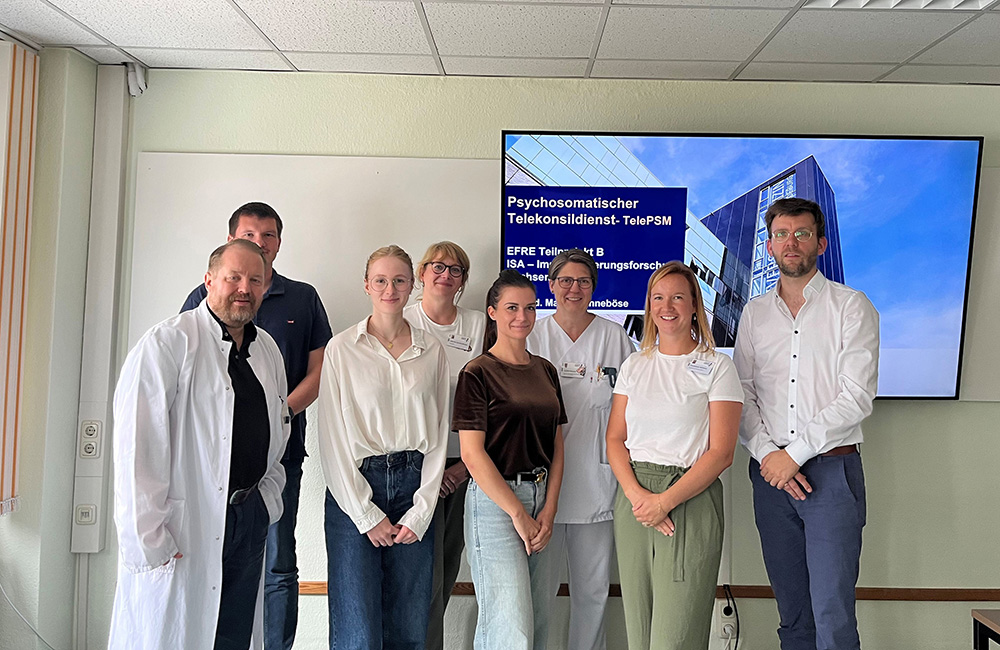
Städtisches Klinikum Dessau to Offer Video Consultations with Magdeburg University Medical Centre
Städtisches Klinikum Dessau to Offer Video Consultations with Magdeburg University Medical Centre

The conference season is starting again.
The conference season is starting again.

Between January and March 2026, four focus groups with regional stakeholders were held on this topic.
Between January and March 2026, four focus groups with regional stakeholders were held on this topic.

Starting in January 2026 - as part of the ISA research project at the University Medical Center Magdeburg
Starting in January 2026 - as part of the ISA research project at the University Medical Center Magdeburg
Partner

Institute for Social Medicine and Health Systems Research (ISMG) Faculty of Medicine, Otto von Guericke University Magdeburg
University Clinic for Psychosomatic Medicine and Psychotherapy (KPSM), University Hospital Magdeburg A.ö.R.

Städtisches Klinikum Dessau, Collaboration Partners in the Teleconsultation Subproject

Johanniter-Krankenhaus Stendal, Collaboration Partners in the Teleconsultation Subproject

Prof. Michel Wensing, PhD, Chair of Health Services Research and Implementation Science, Faculty of Medicine, Heidelberg University
Adjunct Prof. Christoph Nikendei, MD, PhD and Nadja Gebhardt, Department of General Internal Medicine and Psychosomatics, Heidelberg University Hospital
Contact
Do you have questions or feedback regarding our research, or would you like to participate in our studies? We look forward to hearing from you! Please feel free to send us an email, and we will get back to you as soon as possible.


