

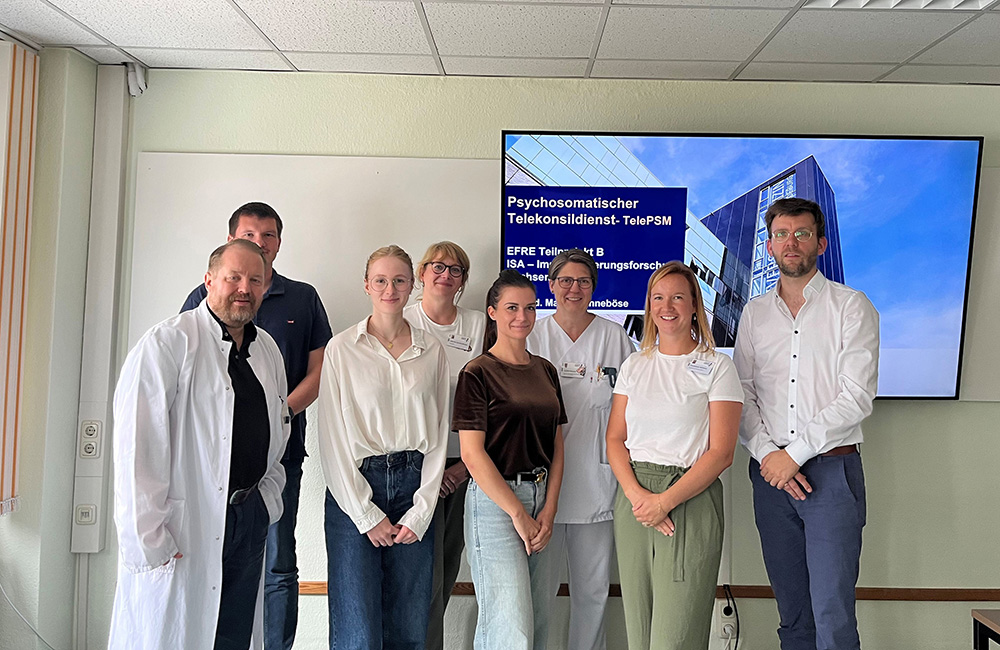
Städtische Klinikum Dessau will offer a new psychosomatic teleconsultation service provided by Magdeburg University Medical Centre as part of the ISA research consortium, funded by the European Regional Development Fund (EFRE). The project aims to introduce innovative forms of healthcare into everyday clinical practice. The new service will give patients access to specialist psychosomatic expertise, even when this is not available locally. The service is scheduled to launch in November 2026.
An important step towards the launch was a joint workshop held by the participating teams in Dessau at the end of August. For the first time, the teams worked through the planned procedures together on site and discussed the practical requirements for implementation. Technical and organisational processes are now being further developed and adapted to the demands of everyday clinical practice.
Many patients experience psychological or psychosomatic difficulties alongside a physical illness. These may include anxiety, depressive symptoms or physical complaints for which no clear underlying organic cause can initially be identified. In such cases, it can be helpful for the treating teams to seek a specialist psychosomatic assessment at an early stage.
“The need for psychosomatic expertise is considerable. At the same time, access to this kind of support is not always readily available, particularly outside major centres,” explains Dr Marius Binneböse, who leads the project together with Professor Florian Junne, Director of the Department of Psychosomatic Medicine and Psychotherapy at Magdeburg University Medical Centre. “With this teleconsultation service, we want to make it easier to bring specialist expertise directly into patient care.”
Through the ISA teleconsultation service, specialists in psychosomatic medicine and psychotherapy at Magdeburg University Medical Centre will be able to support the clinical teams at Städtisches Klinikum Dessau remotely. Using a secure video connection, they will be able to speak with patients, help assess their symptoms and discuss further diagnostic or treatment options.
The remote consultation is not intended to replace the treating team on site. Instead, it will complement their work by giving them direct access to specialist expertise. This could be particularly valuable for hospitals in regions where specialist services are not always readily available, creating an additional link with a university medical centre.
Dr Judith Pannier, Senior Consultant in the Department of Internal Medicine I at Städtisches Klinikum Dessau, says: “Psychological distress and physical illness are often closely linked. We are delighted that the psychosomatic teleconsultation service provided by Magdeburg University Medical Centre will enable us to offer our patients an even more holistic approach to care. We also look forward to using the service to provide targeted advice and support to our doctors and nursing staff. Overall, we hope this will lead to significantly higher patient satisfaction and, ultimately, better health outcomes.”
The teleconsultation service is part of the ISA research consortium at Otto von Guericke University Magdeburg, funded by the European Regional Development Fund (EFRE). The consortium is investigating how innovative models of care, including digital teleconsultations, can be successfully integrated into everyday hospital practice.
The aim is not only to develop and scientifically evaluate new approaches, but also to enable their implementation in routine healthcare, particularly in regions where access to specialist psychosomatic expertise is limited. ISA is therefore helping to bridge the gap between university research and clinical practice in rural areas of Saxony-Anhalt.

